| |
|
A Message From the Director
|
|
|
Greetings BEGA Friends! We are excited for you to join us for Ethics Week 2026, happening October 13-16. This year's theme is Transitioning Ethically and will include courses that are designed to provide employees with the proper ethics tools for making professional and personal transitions. As humans, we are constantly experiencing transitions. A transition is most commonly defined as a change or shift from one state to another. Each transition starts with the need for change. As it relates to ethics, there are specifics rules that relate to transitioning to a new job or career. Be sure to join us for more discussion.

Ashley D. Cooks
Director, Office of Government Ethics
|
|
|
|
New and Notable
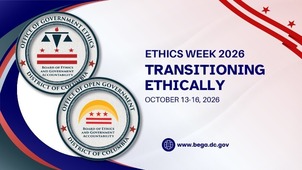
Ethics Week 2026
BEGA’s annual Ethics Week starts next week with a full slate of ethics and open government programming. We will have a full day of courses for Ethics Counselors and another day devoted the Open Meeting Acts and the D.C. Freedom of Information Act. Returning courses include guest speaker Michael Bret Hood, along with the Ethics game show, a presentation from OGE’s Investigators, and Ethics for Government Lawyers with the DC Bar.
Review the schedule and register for courses here: Ethics Week 2026
DC One Fund
October is the start of the DC One Fund campaign. The DC One Fund is the District government’s official workplace giving program and is the only on-the-job charitable solicitation authorized by the District government. Agency coordinators help administer the program and can provide additional information about participating in the DC One Fund.
BEGA has issued guidance on Permitted and Prohibited Activities for D.C. government employees in connection with the DC One Fund:
|
|
|
|
26-0004-F In re Cleo Subido
Respondent appealed a ministerial fine finding that Respondent violated 6B DCMR § 1808.1 by using her District government email for unauthorized purposes. The Board held an adversarial hearing in this matter on October 1, 2026.
26-0099-P In re L. Collins
The Board approved a negotiated disposition with a $20,000 fine with Respondent, a former Deputy General Counsel with DC Public Schools, for two counts of violating the Code of Conduct by engaging in outside employment that was reasonably likely to interfere with ability to perform her job or impair the operation of the District government in violation of DPM § 1807.1(a) and using government time or resources for other than authorized purposed in violation of DPM § 1807.1(b). From 2023 to 2026, Respondent taught multiple in-person courses at Montgomery College during her District tour of duty while teleworking or on leave. Read the agreement here.
|
|
26-0030-P In re J. Zollacoffer
The Board approved a negotiated disposition with a $6,000 civil penalty with Respondent, a former investigator at the Alcoholic Beverage and Cannabis Administration (ABCA), for three counts of violating the Code of Conduct. Respondent used an ABCA vehicle outside of his tour of duty without ABCA approval in violation of DPM § 1808.1, used his position as an ABCA Investigator to threaten a nightlife lounge regulated by ABCA to obtain free or reduced products in violation of DPM § 1800.3(g), and solicited and accepted gifts from the lounge in violation of DPM § 1803.1. Read the agreement here.
|
|
|
Ethics in the News
The U.S. Office of Special Counsel (OSC) recently charged two federal employees with violations of the federal Hatch Act. OSC charged a U.S. Postal Service employee with a knowing violation of the Hatch Act for running for partisan elected position in the state legislature and soliciting contributions for that election. OSC previously investigated the employee for violations of the Hatch Act in 2022 and issued a warning letter. OSC also charged an employee with the U.S. Department of Veterans Affairs with violations of the Hatch Act by running for a state legislative position, knowingly soliciting contributions to their campaign, and using agency resources, including their official email and government-licensed Microsoft Copilot, to engage in political activity while on duty or in the federal workplace. Read more here.
A senior advisor for Senator Mike Rounds of South Dakota is also registered to lobby in South Dakota, raising questions about whether there is a conflict of interest between his work for the Senator and his outside employment as a lobbyist. The staffer is registered to lobby the South Dakota legislature on behalf of 14 clients in the state, from META platforms to trade associations, and is listed as the “co-founder” and “founding member” of a government affairs firm based in the state. Read more here and here.
|
|
|
State and Local Ethics
The position of Lieutenant Governor in New Jersey is currently vacant after the resignation of Former Lt. Gov. Dale Caldwell. Caldwell resigned after an independent investigation commissioned by the Chief Ethics Officer to the Office of the Governor of New Jersey found that he violated ethics rules and sexually harassed a female staffer’s friend. In connection with the violations of the state’s ethics rules, the investigation found that Caldwell brought guests to ticketed events without prior approval and without paying for their attendance and that he tried to secure a promotion for a state employee with whom he had a romantic relationship. Read more about the matter here and read the report here.
A former acting state budget director in New York agreed to pay a $5,000 fine and admitted to violation of the New York Public Officers Law for hiring a friend, who is also a registered lobbyist, to serve as a consultant on a pandemic-related project. The friend was later hired as a subcontractor on the state contract for the same project. The director accepted lodging from the lobbyist at his Florida residence while he was lobbying the agency, appeared as a featured speaker at events held by the lobbyist, and approved the invoice for his work while he was actively lobbying the agency. Read more about agreement here and here.
In another settlement agreement in New York, the former Director of the New York State Police Crime Laboratory System agreed to pay a $2,500 penalty for violating ethics rules in connection with his outside activity. The former director served as a paid consultant to a company that dealt with criminal forensic applications and used his state email and letterhead in his outside business activity. Read the agreement here.
|
|
|
Ask BEGA

Question: I am writing because I’m preparing to begin lobbying in the District for the very first time. I am getting ready to sign my first client, and while I’m excited to get started, I’ve quickly realized that before I can do anything meaningful, I need to understand how to properly register with your office.
Since I am new to lobbying in the District, I am not entirely sure what category I fall under or what fee applies to me. I am not part of a nonprofit organization, and my potential client is not a nonprofit, but beyond that, I am unclear on how the registration structure works or what I should expect to pay upfront. I’ve also heard there are penalties for late filings, though I don’t yet know how those operate or how strict the deadlines are.
Before I proceed—and before I accidentally misunderstand something critical—I would appreciate any clarification on what steps I need to take to register correctly and begin lobbying in compliance with District requirements.
Answer: Thank you for reaching out and welcome to the District’s lobbying program. By contacting us, you’ve already taken an important first step toward successful compliance as a new lobbyist. Based on your question, it is important we start with a summary breakdown of the current registration requirements and fees you will need to follow (effective as of October 1, 2026).
-
Standard Registration Fee: Individual lobbyist, lobbying entities, and most organizations are required to pay annual registration fees of $500. For individual lobbyists and lobbying entities, a separate $500 fee is paid for each client.
-
Nonprofit Registration Fee: Registrants who lobby solely for 501(c)(3) or 501(c)(4) nonprofit organizations must pay $250 annual registration fees.
-
Late Filings: All late filings incur a penalty of $200 per day, up to a maximum of $12,000 per report.
Because your client is not a 501(c)(3) or 501(c)(4) nonprofit organization, you would need to pay the standard $500 registration fee for this client. Once registered, you will also be required to submit quarterly activity reports for as long as you continue lobbying in the District and until you affirmatively terminate your lobbying registration. If you have additional clients, you will need to register and pay the fee and file required reports for each additional client
We encourage you to review the resources and training material linked below:
If you need assistance navigating the e‑filing system or confirming your specific filing deadlines, please feel free to contact us.
|
|
|
|
|
|
Legal Disclaimer:
EIN Presswire provides this news content "as is" without warranty of any kind. We do not accept any responsibility or liability
for the accuracy, content, images, videos, licenses, completeness, legality, or reliability of the information contained in this
article. If you have any complaints or copyright issues related to this article, kindly contact the author above.


